Mindfulness matters in our daily lives much more than we give credit for. Being mindful means recognizing negative patterns of thinking which remove you from the present moment. The type of focus can help bring us into the situation we are in and tackle it with less emotion and more reason. 
The direct definition of mindfulness is as follows:
mind·ful·ness
ˈmīn(d)f(ə)lnəs/
noun
noun: mindfulness
-
the quality or state of being conscious or aware of something.
“their mindfulness of the wider cinematic tradition”
-
a mental state achieved by focusing one’s awareness on the present moment, while calmly acknowledging and accepting one’s feelings, thoughts, and bodily sensations, used as a therapeutic technique. [Google Dictionary]
This therapeutic technique is quite powerful. It can help us navigate tricky emotions, sensation created by injury or tension as well as centers us bringing mind, body and soul together as one. According to
Greater Good: The Science of a Meaningful Life “Mindfulness also involves acceptance, meaning that we pay attention to our thoughts and feelings without judging them—without believing, for instance, that there’s a “right” or “wrong” way to think or feel in a given moment. When we practice mindfulness, our thoughts tune into what we’re sensing in the present moment rather than rehashing the past or imagining the future.”
Meditative mindfulness has it’s roots in the Buddhist tradition and is featured prominently in the Yoga Sutra’s. Meditation is one of the 8-paths of the Ashtanga system as well. It is the key to a sense of inner peace and tranquility that has been honored for thousands of years. “A secular practice of mindfulness has entered the American mainstream in recent years,” Greater Good said, “In part through the work of Jon Kabat-Zinn and his Mindfulness-Based Stress Reduction (MBSR) program, which he launched at the University of Massachusetts Medical School in 1979. Since that time, thousands of studies have documented the physical and mental health benefits of mindfulness in general and MBSR in particular, inspiring countless programs to adapt the MBSR model for schools, prisons, hospitals, veterans centers, and beyond.”
A free, and easy way to release your mind from the anxieties of everyday we all have the ability to practice mindfulness by simply shifting our attention to the breath. Taking ten deep breaths in a given moment calms the nervous system, allows the adrenals a momentary rest, and gives you the opportunity to observe the thoughts in your mind. Taking a step back and observing emotions non-judgmentally often gives us the insight needed to tackle the situation from a calm, confident state.
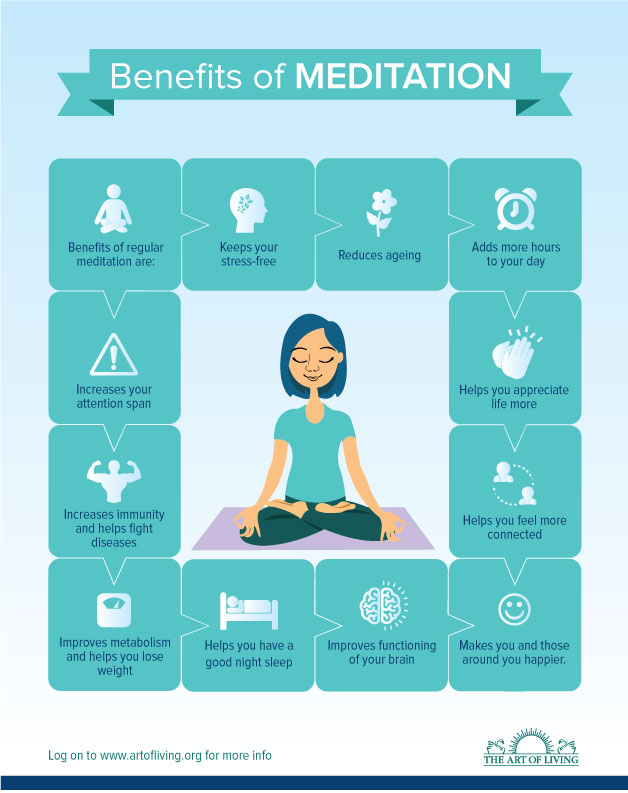
The Art of Living Foundation describes the benefits of a regular meditation practice in an amazing info-graphic below.
The Art of Living Foundation pinpoints the affects of meditation, noting they are two fold: physical and mental. The physical benefits of mediation include lower blood pressure, lowering of blood lactate which increases the risk of anxiety attacks, decreases tension related pain such as headaches, ulcers, insomnia and muscle and joint problems, increases serotonin production to improve mood and behavior, improves the immune system and gives the practitioner renewed energy. The emotional benefits of meditation include a decrease in anxiety, emotional stability improves, creative increases, happiness increases, intuition develops, gain clarity and peace of mind, problems become smaller, and finally, meditation sharpens the mind by gaining focus and this focus expands through relaxation.
The Art of Living Foundation also notes three interesting results from mindful meditation. The first is the ability to gain emotional stability and harmony. This is a very important affect of our meditation practice as it allows us to really get into the emotions that truly effect us from trauma to happiness and rid ourselves of the emotions which no longer serve us. Anxiety may always exist. In fact we know there are two types of stress/anxiety, good and bad. The ability to pinpoint triggers for anxiety and stress allows us to decided if the stressful situation or if the stressful feelings are “serving us” anymore. Often, we find much of our emotion rooted in fear and self-doubt. Mindful meditation can afford you the ability to pin point which emotions are coming from these negative thought patterns and then enables the practitioner to “let go” of negative thought patterns by breathing out fear and doubt with each mindful breath cycle. Therefore upon completing the meditation session the practitioner is weight down by less, and up-lifted by positive stress or the drive to move forward, past fear, allowing our wildest dreams to manifest.
The second layer result is that of harmony in creation. Our pineal gland, located in the forehead, around the third eye or between the brows is the way we make sense of out outer and inner worlds. The pineal gland makes sense of the information we take in, and considers how this information matches to experiences we have already had. Meditation allows us to rest the mind’s eye or pineal gland. This type of rest can allow a little bit of enlightenment when it comes to the third eye, allowing the practitioner to see the world a littler differently. We start to become more aware of our place in the world, and more confident in our interactions with it. “When you meditate, you are in the space of vastness, calmness and joy and this is what you emit into the environment, bringing harmony to the planet.”
Finally, mindful meditation can bring on personal transformation. A few minutes everyday can lead you to a better understanding of who you are, and who you would like to become. In stillness the most prominent thoughts, feelings and anxieties come to the forefront. It is here we are able to choose which sentiments we would like to take with us into the world. During meditation we get to know ourselves, fostering a deep, important relationship with your inner most character. Gone is the wanting and the stories, the hurt or the happiness, in the stillness the soul simmers and the practitioner gets an opportunity to see an inner light, prana, or life force that exists in us all. This sense of clarity allows us to see we are perfect as we are, right were we are, and each of us has something incredibly special to offer. Mindful meditation allows the practitioner to develop the most important relationship in their life, the relationship they have with oneself.

This relationship is the only relationship you will maintain until you die, and in getting to know yourself you can move forward and live the life you want, free from anxiety, fear or doubt.
So how do you actually do it? I recommend starting for about five minutes and working your way to around 15 minutes. This is a daily practice to pick a length that works best for you and make it a routine. It can be great to incorporate other aspects of your day into your meditation like the making of hot lemon water, coffee or perhaps oil pulling. Some practitioners use
Mala beads to help them count breath or intention. Make sure you have a block, bloster, zafu, pillow or even a chair to help maintain a straight flat back. If sitting upright becomes an issue find a walk, place your bum against the banister and use the wall for spinal support. Make sure, and double check that you turn you phone on airplane mode (not silent) and then grab a timer and make sure you set it for the intended amount of time.
Spend the first few moments getting comfortable and then clear your mind and come into the breath. Focus on the inhales and exhales as the enter and exit the body through the nose. Notice the breath cascading on the top lip. Enjoy the sensation.
Engage the abs and core slightly to help hold up the ribs and actively roll the shoulders back and down, pressing down so to elongate the neck. Perhaps you would like to repeat a mantra softly to yourself. I recommend four or five words in a short sentence. Pick something that resonates with you. My mantra is “I am stillness in the world”. Kathryn Budig, a popular yoga instructor at Yoga journal uses ““I am energized. I am focused.” Bring your hands softly to rest on the knees or at heart center and sit for as long as you can in stillness or until your timer goes up. Notice the flow of breath in your body, as well as any sensations that come up while trying to stay out of the mind not allowing yourself to get wrapped up in the minds stories. Remember, we rarely spend time with our bodies, and almost all of our time in our minds. Take sometime today and reconnect with your biggest and most important assent in your life – You.
And if you just quite can’t get into it here are a few more tips from Tiny Buddha including the 100 breath technique as well as tips for a meditatnap.
Happy mindful meditation!

 The Art of Living Foundation pinpoints the affects of meditation, noting they are two fold: physical and mental. The physical benefits of mediation include lower blood pressure, lowering of blood lactate which increases the risk of anxiety attacks, decreases tension related pain such as headaches, ulcers, insomnia and muscle and joint problems, increases serotonin production to improve mood and behavior, improves the immune system and gives the practitioner renewed energy. The emotional benefits of meditation include a decrease in anxiety, emotional stability improves, creative increases, happiness increases, intuition develops, gain clarity and peace of mind, problems become smaller, and finally, meditation sharpens the mind by gaining focus and this focus expands through relaxation.
 This relationship is the only relationship you will maintain until you die, and in getting to know yourself you can move forward and live the life you want, free from anxiety, fear or doubt.
 alexatomaszewski.com